
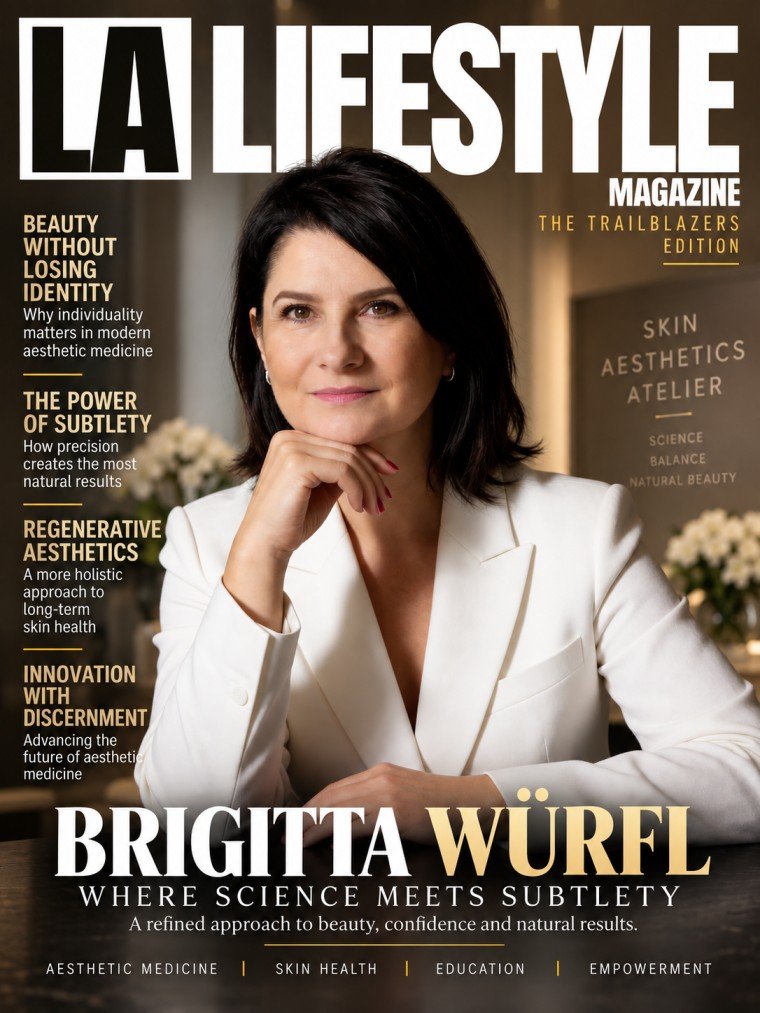
Beauty is changing. As aesthetic treatments become more advanced and conversations around aging become more nuanced, an increasing number of people are moving away from dramatic transformations and toward results that feel natural, personal, and authentic. For Brigitta Würfl, founder of Skin Aesthetics Atelier, this evolution reflects a deeper shift in how people understand aesthetic medicine.
Rather than attempting to reshape every face according to a popular ideal, Würfl believes aesthetic treatments should preserve individuality while enhancing the qualities that already make someone distinctive. The goal is not to create an entirely different appearance but to help people look refreshed, healthy, and confident while still looking unmistakably like themselves.
Beauty Without Losing Identity
For years, aesthetic trends often emphasized visible changes—defined contours, pronounced features, and transformations that could immediately be recognized. Today, however, many patients are approaching aesthetic medicine with a different mindset.
They are looking for treatments that support their appearance rather than dominate it.
At Skin Aesthetics Atelier, Würfl takes an individualized approach to treatment planning. Facial proportions, skin quality, movement, anatomy, lifestyle, previous procedures, and personal expectations all form part of the broader picture.
This philosophy recognizes that there is no universal definition of beauty. What works for one person may be entirely inappropriate for another. A treatment plan should therefore begin with understanding the individual, including what they wish to improve and, equally importantly, what they want to preserve.
Sometimes, the most appropriate treatment may even be less treatment.
Why Subtlety Requires Precision
Creating an obvious transformation can be visually striking, but achieving a refined and understated result requires a different level of precision. Small decisions can have significant consequences when the objective is to preserve natural facial harmony.
A practitioner must consider anatomy, symmetry, proportions, facial movement, skin condition, and the relationship between different areas of the face. Knowing where intervention may help is only part of the process; understanding where intervention is unnecessary can be equally important.
For Würfl, one of the strongest indicators of a successful treatment is when someone appears rested and rejuvenated without immediately revealing why they look different.
This approach places aesthetic judgment alongside medical knowledge. It is an understanding that enhancement does not necessarily mean excess.
Moving Beyond Social Media Beauty Templates
Social media has transformed the way people discover beauty treatments. It has created unprecedented access to information, but it has also contributed to the rapid spread of standardized beauty trends.
When a particular facial contour, lip shape, or aesthetic style becomes fashionable, individuals can easily begin comparing themselves with highly curated images and believing that they need to reproduce the same appearance.
Würfl advocates a return to individuality.
Every face has its own proportions, expressions, structure, and character. Instead of asking how someone can be made to resemble a popular image, the more meaningful question is how treatment can complement the person’s existing features.
This philosophy places authenticity at the center of aesthetic care. Beauty does not need to follow a single template.
Personalization as the Foundation of Aesthetic Care
Individualized treatment is central to Würfl’s approach. Two patients may arrive with similar concerns while requiring completely different strategies.
Age, anatomy, skin condition, lifestyle, facial dynamics, previous treatments, expectations, and desired outcomes can all influence clinical decisions. This makes consultation an essential part of the process.
Listening to a patient can be just as important as examining their facial features. Understanding what makes someone uncomfortable, what they hope to achieve, and which characteristics they want to retain allows treatment to become more thoughtful and precise.
This patient-centered philosophy also creates room for honest recommendations. Not every characteristic needs to be corrected, and not every concern requires an immediate procedure.
The Growing Role of Regenerative Aesthetics
One of the most significant developments in modern aesthetic medicine is the increasing interest in regenerative approaches. Rather than concentrating exclusively on concealing visible signs of aging, regenerative aesthetics places greater attention on tissue quality and biological processes.
Treatments such as platelet-rich plasma (PRP), which uses components derived from a patient’s own blood, have become part of this broader conversation. PRP contains naturally occurring growth factors and is used in approaches intended to support processes associated with tissue repair and collagen production.
For Würfl, the appeal of regenerative aesthetics extends beyond a single procedure. It represents a broader philosophy: instead of focusing exclusively on immediate visual correction, aesthetic care can also consider the long-term condition and vitality of the skin.
From Quick Corrections to Long-Term Skin Health
The growing interest in regenerative treatments reflects a wider change in patient expectations. Immediate results remain appealing, but many people are increasingly interested in maintaining healthy-looking skin over time.
A comprehensive aesthetic strategy may involve prevention, personalized skincare, skin-quality treatments, regenerative approaches, and carefully selected procedures. Rather than attempting to stop aging altogether, the emphasis can shift toward supporting a healthy and vibrant appearance throughout the aging process.
This creates a more continuous relationship between practitioner and patient. Aesthetic medicine becomes less about isolated corrections and more about developing a considered, long-term approach to skin health and appearance.
Sharing Knowledge Beyond the Treatment Room
Würfl’s work extends beyond individual patient care. She is also committed to professional education and the exchange of knowledge within the aesthetics community.
Her involvement in workshops, training initiatives, and international professional events reflects her belief that practitioners need more than technical knowledge to deliver responsible aesthetic care. A strong understanding of anatomy, patient selection, treatment limitations, possible complications, ethics, safety, and realistic expectations is equally important.
This commitment to education was recently highlighted when she was invited to the BEAUTY FORUM Day in Stuttgart as a speaker.
During the event, Würfl had the opportunity to conduct a workshop focused on collagen stimulators, a subject particularly close to her professional interests. The session provided an opportunity to share her knowledge and experience while engaging with participants through questions and professional discussion.
The event also gave her an opportunity to express her appreciation to everyone who attended, noting the participants’ interest, attention, thoughtful questions, and the valuable professional exchange. She also extended her gratitude to BEAUTY FORUM DE for the invitation and organization of the event.
Her workshop centered on collagen stimulation and modern aesthetic treatment options, reflecting the growing interest in approaches that focus on skin quality and biological processes rather than simply creating immediate visible changes.
For Würfl, education is not simply about passing on techniques. It is about encouraging professionals to examine the science behind emerging treatments and make informed decisions about whether new approaches genuinely benefit their patients.
Innovation Requires Discernment
Aesthetic medicine is developing rapidly, with new technologies, procedures, and treatment concepts appearing constantly. Yet Würfl emphasizes that innovation should always be accompanied by critical evaluation.
A treatment should not be adopted simply because it is new or trending online. Practitioners have a responsibility to understand the available evidence, anatomy, indications, contraindications, limitations, and safety considerations before introducing a new approach into their practice.
In a field heavily influenced by social media, the ability to distinguish meaningful innovation from temporary popularity becomes increasingly important.
For Würfl, responsible progress requires curiosity combined with professional judgment.
Recognition With a Greater Purpose
Professional recognition can provide valuable visibility, but Würfl sees its significance as extending beyond personal achievement.
Recognition can create opportunities to discuss professional standards, responsible treatment, scientific development, education, and patient-centered care. In this sense, acknowledgment becomes most meaningful when it contributes to a wider conversation about improving the field.
Leadership in aesthetic medicine is not limited to public visibility. It can also be expressed through teaching, professional responsibility, knowledge sharing, and a commitment to advancing thoughtful standards of care.
The Future of Aesthetic Medicine
Looking ahead, Würfl believes aesthetic medicine will continue moving toward greater individualization.
Patients are becoming more informed and increasingly interested in maintaining their identity rather than dramatically altering their appearance. This will require increasingly sophisticated treatment planning that combines anatomical understanding, regenerative approaches, personalized skincare, prevention, and long-term attention to skin health.
The pursuit of a standardized version of perfection may gradually give way to something more personal: authenticity.
This evolution does not mean abandoning aesthetic medicine. Instead, it suggests a broader understanding of what aesthetic treatment can achieve. The objective can be to support confidence while respecting the features that make each person unique.
The Beauty of Looking Like Yourself
For Brigitta Würfl, the most successful aesthetic treatment is not necessarily the one that produces the most dramatic before-and-after photograph.
Sometimes the most meaningful result is one that preserves a person’s identity while helping them feel more comfortable and confident in their appearance.
Her philosophy at Skin Aesthetics Atelier is built around precision rather than excess, biological understanding rather than superficial correction, and individuality rather than imitation.
As aesthetic medicine continues to evolve, this perspective offers a different way of thinking about beauty. The future may not belong to changing people into a predetermined ideal but to helping them maintain healthy, balanced, refreshed appearances while remaining completely themselves.
Ultimately, the most sophisticated aesthetic result may be the one that does not make someone look like somebody else at all—it simply allows them to look, feel, and recognize themselves at their very best.
Leave a Reply