
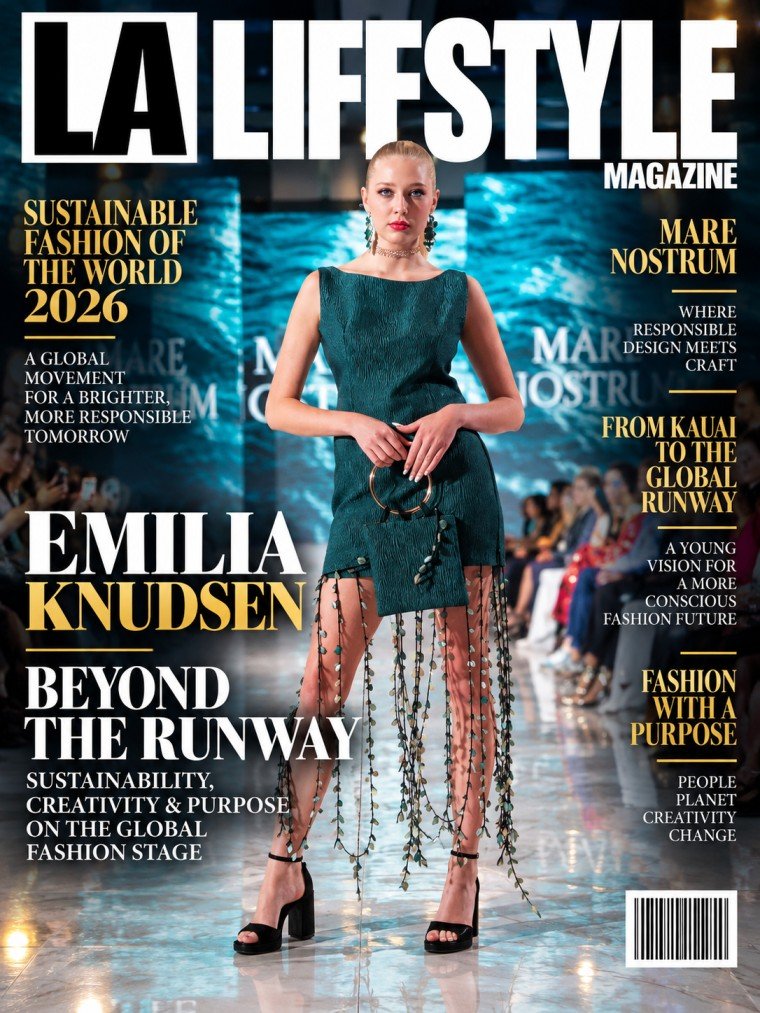
From Sustainable Fashion of the World 2026 in Panama to her island home of Kauai, Hawaii, international model and young entrepreneur Emilia Knudsen is championing a new vision of beauty—one rooted in environmental responsibility, cultural heritage, and the power of individual action.
When Fashion Becomes a Force for Change
Fashion has always been a powerful expression of creativity, identity, and culture. But in an era of growing environmental awareness, the industry faces an important question: Can beauty do more than inspire? Can it also help change the world?
For 17-year-old international runway model, entrepreneur, and humanitarian Emilia Knudsen, the answer is yes.
Born and raised on the Hawaiian island of Kauai, Knudsen has traveled internationally, experienced diverse cultures, and collaborated with talented designers. Among the defining experiences of her modeling journey was her participation in Sustainable Fashion of the World 2026, held in Panama City from July 23 to 26.
Organized by the Love for Upcycling Foundation, the inaugural four-day event brought together designers, artists, educators, sustainability advocates, and creative professionals representing 11 international markets. Through runway presentations, exhibitions, educational activities, and cultural exchange, the event explored how fashion can encourage responsible consumption, innovative design, and a deeper commitment to protecting the planet.
For Knudsen, the experience represented something far greater than a traditional fashion showcase.
“It reminded me that a runway can be more than a place to showcase beautiful designs,” she believes. “It can be a platform to inspire people to think differently, challenge old habits, and recognize our responsibility to protect the world we share.”
Sustainable Fashion Takes Center Stage in Panama
Sustainable Fashion of the World 2026 presented a compelling vision for the future of the fashion industry—one in which artistic expression and environmental consciousness work together.
Rather than treating sustainability as a limitation, the event demonstrated how responsible material choices, upcycling, and cultural craftsmanship can open new possibilities for designers.
The gathering also established Panama as an emerging meeting point for international conversations about sustainable creativity, bringing together established designers and emerging talent to explore the relationship between fashion, society, education, and the environment.
Among the models who brought these ideas to life on the runway was Knudsen, whose participation reflected a growing movement among young fashion professionals to use their visibility to encourage more thoughtful choices.
Her role extended beyond presenting garments. By showcasing designers’ creations, she helped communicate a message that resonates throughout the sustainability movement: creativity does not have to come at the expense of the environment.
In fact, the challenge of creating responsibly can inspire some of fashion’s most imaginative work.
Mare Nostrum: Where the Beauty of the Sea Meets Responsible Design
One of the event’s standout moments centered on Mare Nostrum, a collection by Ana Cecilia Requena of Miroslava Atelier. Inspired by the Mediterranean Sea and the relationship between nature, architecture, and craftsmanship, the collection explored how sustainable design can combine timeless elegance with contemporary artistic expression.
Knudsen presented pieces from the collection, helping bring Requena’s creative vision to the international runway.
The collection’s distinctive design demonstrates how discarded and surplus materials can be transformed into sophisticated fashion.
One of its notable dresses was crafted from deadstock upholstery fabric, giving surplus textiles a new purpose. Its elongated silhouette evokes the elegance of classical architectural columns, while cascading fringes introduce movement, texture, and fluidity.
The detachable fringes were hand-crocheted from recycled cotton and adorned with individually selected, cut, and hand-painted fish scales. This detail reinterprets a traditional Panamanian craft through a contemporary design perspective.
The commitment to reducing waste continued throughout the ensemble. Remaining fabric was transformed into a coordinating handbag, while handcrafted fish-scale earrings completed the look.
The collection’s name, Mare Nostrum, comes from the Roman expression meaning “Our Sea,” traditionally associated with the Mediterranean. Its designs bring together classical beauty and Panamanian artisanal heritage, creating a dialogue between tradition, innovation, and environmental awareness.
Requena’s approach earned recognition for Best Use of Materials, celebrating her ability to combine thoughtful resource selection with artistry and design innovation.
The collection illustrated an important principle: sustainability is not simply about choosing different materials. It is about rethinking the entire creative process, from the origins of a fabric to the possibilities that remain after a garment is made.
For Knudsen, presenting these designs was an opportunity to show how fashion can communicate respect for nature without sacrificing elegance or originality.
The Island That Shaped Her Perspective
Although her international experiences continue to broaden her outlook, Knudsen’s commitment to environmental responsibility is deeply connected to where she grew up.
Kauai, surrounded by the Pacific Ocean, lush mountains, waterfalls, and extraordinary natural landscapes, has shaped her understanding of the relationship between people and the environment.
In Hawaiian culture, the concept of mālama ʻāina emphasizes caring for and nurturing the land. For Knudsen, it is more than an expression; it is a guiding principle.
Growing up surrounded by nature reinforced the understanding that the environment is not something humanity owns without obligation. It is something to respect, preserve, and protect.
Her international travels have further strengthened this perspective.
Oceans connect continents, and environmental challenges rarely remain confined to the places where they begin. Plastic waste discarded far from a coastline can eventually threaten marine ecosystems thousands of miles away. The consequences of environmental neglect can extend well beyond national and geographical boundaries.
Whether someone lives on a remote island, in a major city, or in a rural community, the underlying responsibility remains the same.
We share one planet, and the choices we make collectively shape its future.
Rethinking What It Means to Be Fashionable
The fashion industry offers enormous opportunities for creativity, but its future also depends on its willingness to reconsider patterns of production and consumption.
Sustainable fashion encourages people to look beyond trends and think more carefully about how clothing is designed, manufactured, purchased, worn, and eventually reused.
For consumers, that can mean choosing quality over quantity, repairing garments instead of replacing them, exploring vintage clothing, and supporting designers who prioritize responsible production.
For designers, it can mean finding innovative ways to use existing materials, reducing waste during production, preserving traditional craftsmanship, and creating pieces designed to last.
For models, photographers, influencers, and other creative professionals, it means recognizing that public visibility can be used to promote meaningful ideas.
Knudsen believes the industry does not need to abandon beauty or creativity to become more responsible. Instead, sustainability offers an opportunity to redefine what makes fashion truly valuable.
The most meaningful expression of luxury may not be constant consumption or endless newness. It may be the quality of a garment, the skill behind its creation, the story of its materials, and the care taken to minimize its impact.
The future of fashion should be measured not only by what looks beautiful today but also by the world that remains for future generations.
Small Choices, Collective Impact
Sustainability can sometimes feel overwhelming, particularly when environmental challenges appear too large for any one person to influence.
Yet Knudsen believes that individual actions matter, especially when they become shared habits across communities.
The starting point does not have to be complicated.
Buying fewer, better-made products can help reduce unnecessary consumption. Reusable water bottles, shopping bags, and containers can reduce reliance on single-use plastics. Thoughtful meal planning can limit food waste, while composting can help make better use of organic materials.
Protecting beaches, parks, and natural spaces through community cleanups and responsible outdoor behavior can also contribute to healthier environments.
Supporting local farmers, artisans, businesses, and organizations that respect people and the planet helps strengthen communities while encouraging more responsible practices.
Perhaps just as importantly, individuals can inspire others by sharing knowledge and demonstrating sustainable habits in everyday life.
However, personal responsibility is only part of the solution. Businesses, governments, and industries also have important roles to play in making sustainable choices accessible and practical.
Lasting change requires cooperation across society.
No one needs to be perfect to make a difference. What matters is the willingness to learn, improve, and act consistently.
When millions of people make more conscious decisions, small actions can contribute to a much larger movement.
A Young Entrepreneur With a Humanitarian Mission
Knudsen’s commitment to positive change extends beyond fashion and environmental awareness.
As a young entrepreneur and humanitarian, she began her first business at nine years old and later became involved in humanitarian projects supporting families and communities in need.
One of her current efforts involves helping raise funds to build a deep-water well in Uganda, with the goal of improving access to clean water for a community in need.
The initiative reflects a broader understanding of sustainability—one that recognizes the connection between environmental protection and human well-being.
A sustainable future is not simply a world with less pollution and cleaner oceans. It is also a world in which communities have access to essential resources and opportunities to thrive.
Clean water, education, health, and economic opportunity are integral to the long-term well-being of people and the environments in which they live.
For Knudsen, humanitarian work and sustainability share a common foundation: recognizing that our choices can improve the lives of others, even when those people live far beyond our immediate communities.
Her work also reflects a belief that young people should not underestimate their ability to contribute to meaningful change.
Age does not have to determine the size of someone’s ambition or the value of their contribution. Young people can become entrepreneurs, advocates, community leaders, and participants in conversations that will shape their generation’s future.
Beyond One Event: Building a Global Movement
Sustainable Fashion of the World was conceived as more than an annual runway event. Under the leadership of the Love for Upcycling Foundation, its broader mission is to encourage transformation across fashion, education, society, and environmental responsibility.
By connecting designers, universities, international organizations, emerging talent, and sustainability advocates, the initiative aims to encourage responsible production, circular design, and innovative approaches to reusing materials.
Its inaugural edition in Panama established a foundation for future international collaboration.
Looking ahead to its second edition, planned for September 2027, the initiative intends to expand its vision beyond fashion to include architecture, art, education, technology, and the circular economy.
This broader perspective recognizes that sustainability is not the responsibility of a single industry. It is a shared challenge that calls for creativity and collaboration across disciplines.
Fashion can help communicate that message because it is both personal and universal. Clothing connects craftsmanship, culture, identity, business, and the materials drawn from the natural world.
When designers and creative professionals use their work to encourage responsible choices, the runway becomes a platform for conversations that extend far beyond the event itself.
Redefining Success for the Next Generation
As Knudsen continues her journey through modeling, entrepreneurship, and humanitarian work, her message remains grounded in a simple idea: meaningful change begins when people recognize their ability to contribute.
We do not need to be famous, wealthy, or influential to make a difference. We need to care enough to make thoughtful choices and encourage others to do the same.
For the next generation, success can mean more than personal achievement, professional recognition, or material accumulation. It can also be measured by what we contribute to our communities, what we preserve for the future, and how we help others along the way.
That perspective offers a different way to think about beauty, too.
Beauty can be found in a thoughtfully designed garment made from surplus materials, in a coastline protected from pollution, in a community gaining access to clean water, and in the collective effort to preserve the natural world.
These are not separate causes. They are interconnected expressions of a shared responsibility.
Knudsen’s experience at Sustainable Fashion of the World 2026 reinforced the importance of bringing creativity and purpose together. Through the example of designers such as Ana Cecilia Requena, the event showed how fashion can honor craftsmanship, reduce waste, and inspire new ways of thinking.
And through her own environmental and humanitarian commitments, Knudsen continues to advocate for a future in which ambition and responsibility go hand in hand.
One Planet. One Future. One Shared Responsibility.
From the shores of Kauai to the international runway in Panama, Emilia Knudsen’s journey reflects an evolving understanding of what fashion can represent.
It can be a celebration of artistic talent and cultural diversity. It can create opportunities for innovation and collaboration. It can also encourage people to reconsider their relationship with the products they buy, the resources they use, and the planet they share.
Sustainable Fashion of the World 2026 offered a compelling example of these possibilities, bringing together creative voices around a common purpose.
The message emerging from the event is both simple and powerful: being fashionable today also means being responsible.
For Knudsen, the most beautiful legacy is not something we wear, own, or display. It is a healthier planet, cleaner oceans, thriving communities, and a future filled with possibility.
The question is no longer whether one person can change the world.
The question is, what if each of us decided to try?
Image Credit:- Randy Ayazo PH
Leave a Reply