
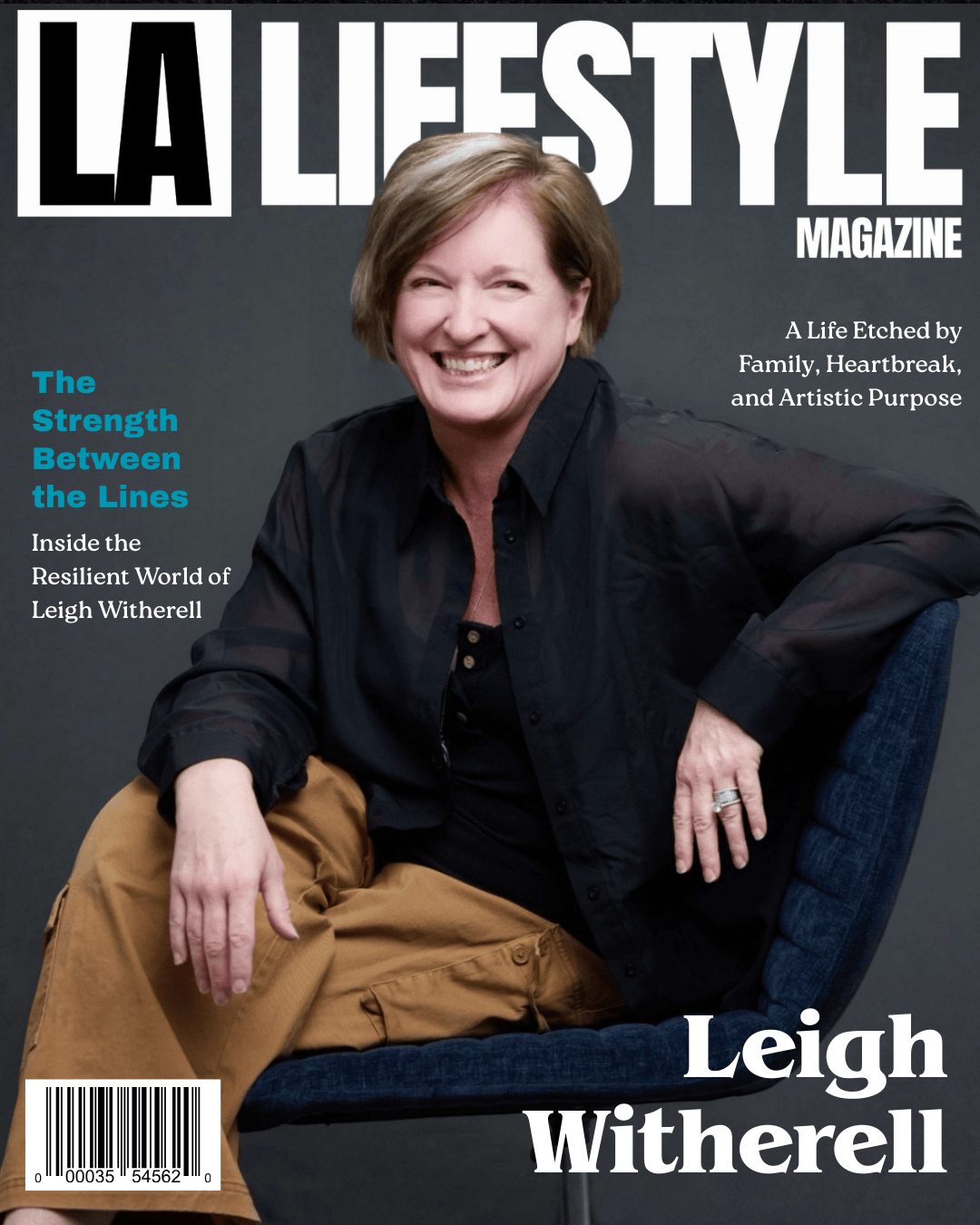
Leigh’s art holds a quiet intensity—the kind that arrives from lived experience rather than theory. Her work looks at relationships, the human body, and the emotions that live in the small, often unspoken moments. Behind those images is a life shaped by family, hardship, devotion, and an unshakable habit of getting back to the studio each morning.
A lineage of resilience
Resilience, Leigh says, is less a talent than an inheritance. It comes from the women in her family—from a grandmother who made the most of very little and from a maternal line raised on hard farm living. Those early lessons taught her not to dwell on what “should be,” but to face what is and then make the best of it.
That practical toughness has sustained her through the high points and the unbearable ones. Raising children, finishing degrees, building a life—those were demanding years. But when she lost her 32-year-old daughter, Leigh found that the gift she’d received from the women before her was the only thing that got her out of bed some days. “I can’t make the most of her death,” she says; still, resilience propelled her back into the studio and allowed her to keep living a life shaped by art.
From classrooms to the canvas
Leigh’s adult life has been a careful balancing act between family, study, and creativity. She spent much of her early adulthood raising her children while earning two degrees in literature—a period she looks back on fondly despite the challenges of young parenthood. After teaching English literature at a local college and later moving to Florida, a new chapter opened: with her husband’s encouragement (and financial stability), she was able to devote herself to art full time.
That support has been pivotal. Leigh talks plainly about the privilege of having a partner who allowed her to take risks and pursue a creative career. Married for 36 years, the two have been each other’s staunchest allies. But committing to art also meant learning how to run a small business—an aspect of an artistic life she initially resisted. Over time she discovered that mastering the practicalities of success freed her imagination rather than constraining it.
Three qualities that shape her work
If Leigh had to name the essential tools of her practice, she would pick three: curiosity, listening, and empathy.
- Curiosity. A lifelong interest in people—their gestures, their expressions, and the fleeting shifts of feeling—fuels her compositions. She wants to capture those moments that reveal something true and surprising about human nature.
- Listening. Raised among storytellers, Leigh learned early how to listen—and how to hear what isn’t said. That ability to sense the space between words is central to her process; it lets her translate silence and subtext into imagery.
- Empathy. The trust people place in her—to share stories, to be seen—matters deeply. Empathy enables her to enter others’ lives without exploiting them. It’s why subjects feel comfortable and why her work often holds secrets as much as it reveals them.
Working under pressure: art, nudity, and censorship
Leigh makes art that engages with the human form and sexuality—not prurient images, but explorations of intimacy, vulnerability, and the changing nature of relationships. Lately she’s had to defend her work from digital censorship. Social platforms, she argues, are increasingly acting as moral gatekeepers, removing or restricting images that have always been part of artistic traditions because they show nudity or sexual expression.
This policing of the body troubles her. “Nudity has been in art since art began,” Leigh observes. To her, the human form is a subject for celebration and honest inquiry, not shame. She worries about a cultural climate in which platforms substitute their judgment for that of parents and communities, and where conversations about emotion and sexuality are increasingly silenced.
If there were only ten years left
Asked to imagine having a decade left to live, Leigh doesn’t talk about retreating from controversy; she talks about continuing her work with purpose. Her art—especially the fine-art nudes that explore human connection—would remain central. She feels urgency about preserving the freedom to depict the body and emotion honestly, and she would keep arguing for the visibility of that work.
Moving forward
Leigh’s story is a reminder that art is rarely produced in a vacuum. It is the product of history, family patterns, education, grief, and daily discipline. Her practice is sustained by a clear-eyed resilience handed down through generations, sharpened by intellectual curiosity, and softened by deep empathy. The result is work that asks viewers to look more closely—to notice what lies between the words and to remember that the human body and its feelings have always been central to the stories we tell.
Leave a Reply