
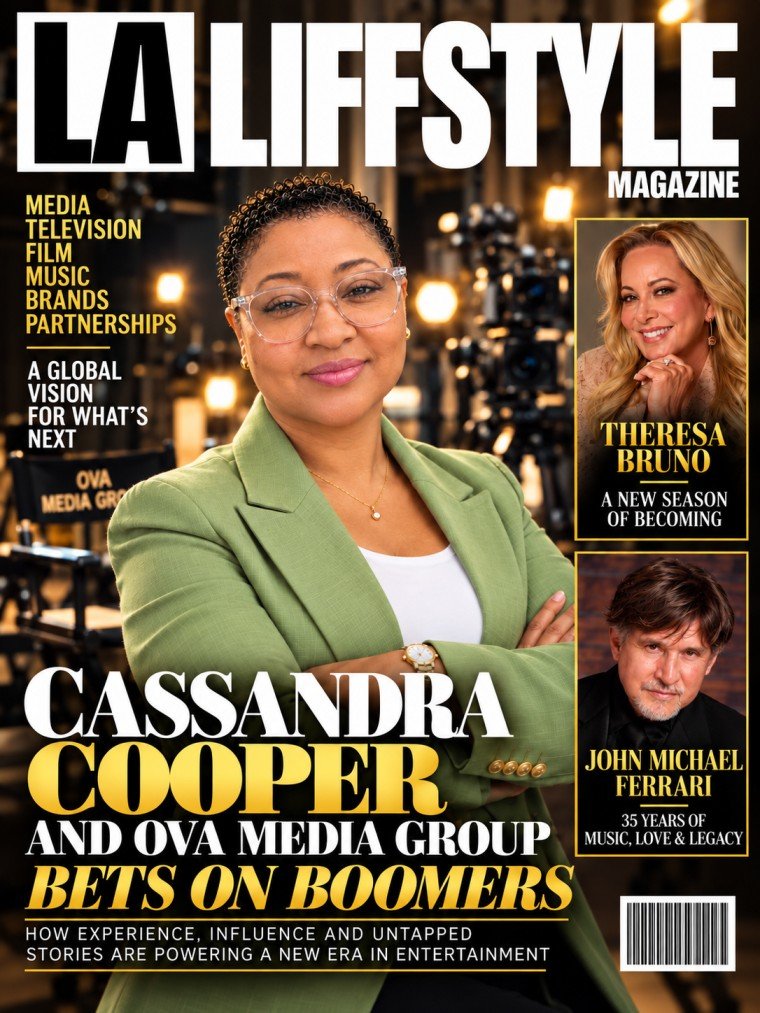
Hollywood Chases Youth. Cassandra Cooper Sees the Power, Influence, and Untapped Potential of a Generation That’s Just Getting Started.
In an entertainment industry that often seems preoccupied with youth, Cassandra Cooper is looking in a different direction. She sees opportunity in a generation that has helped shape modern culture, built businesses, raised families, transformed industries, and accumulated decades of experience—and that still has plenty of life, ambition, and creativity ahead.
For Cooper, the Baby Boomer generation is more than an overlooked audience. It represents a significant opportunity to rethink how entertainment is developed, marketed, distributed, and monetized.
As the founder of Ova Media Group, Cooper is building a business around that conviction, bringing together television, film, streaming, music, branding, and talent development to create new opportunities for established personalities and independent creators. Her strategy reflects a career spent navigating the creative and commercial sides of entertainment, often turning ideas that existed only on paper into functioning businesses, completed productions, and platforms capable of reaching audiences across borders.
“Hollywood keeps chasing the next generation. I’m betting on the generation that has the experience, the influence, the purchasing power, and the freedom to make its next chapter extraordinary” is the philosophy that captures the thinking behind her latest chapter.
It is also a natural extension of the mission that has guided her work for years: creating opportunities for people whose stories deserve to be heard.
Building a Different Kind of Media Company
Cooper founded Ova Media Group to address a disconnect she saw throughout the entertainment industry. There was no shortage of talent, compelling ideas, or stories waiting to be told. What was often missing was access to meaningful opportunities, ownership, and distribution.
For independent filmmakers, emerging content creators, and underrepresented voices—particularly women of color—the challenge was not simply producing a project. It was finding a sustainable path from a creative concept to an audience.
Cooper wanted to help close that gap.
Rather than waiting for traditional Hollywood gatekeepers to decide which stories deserved attention, she set out to build a platform that could support independent creators through multiple stages of the process, from development and production to distribution and audience engagement.
That vision has shaped Ova Media Group’s evolution from a traditional over-the-air television operation into a multiplatform entertainment business with international distribution capabilities.
Its programming has been available through Roku, Apple TV, Amazon Fire TV, mobile applications, online streaming, and broadcast television, reaching audiences across the United States, the United Kingdom, Africa, and the South Pacific.
The company’s library has expanded to include hundreds of titles spanning films, scripted and unscripted television, music programming, documentaries, and classic cinema.
For Cooper, this evolution represents more than technological progress. It reflects a fundamental change in how entertainment businesses must operate.
Content creation is only one part of the equation. A successful media enterprise must also understand its audience, identify the right distribution channels, develop recognizable brands, establish commercial partnerships, and create a business model that can support continued growth.
Cooper’s approach brings those elements together. She is interested not only in producing entertainment but also in developing intellectual property and building long-term value around the people and stories behind it.
From Production Operations to Measurable Growth
Cooper’s experience extends well beyond the development of her own company. Her career includes executive production, film and television management, intellectual property development, digital distribution, and studio operations.
Her earlier professional experience includes work associated with Paramount Pictures, along with independent film and television production through Matriarch Multimedia Group and Step1TV Studios.
One of her most significant operational achievements came during her work as general manager and studio executive at Wonderland Studios in California.
The facility encompassed approximately 88,000 square feet, including six soundstages and post-production facilities, as well as an additional 88 acres designated for potential future development. Managing a property of that scale required an understanding of production infrastructure, operational efficiency, business development, and the commercial realities of keeping a studio competitive.
Through operational restructuring, strategic business development, and a renewed focus on maximizing the property’s production capabilities, Cooper helped drive a reported 110 percent increase in studio revenue.
The accomplishment illustrates a defining characteristic of her career: an ability to connect creative ambition with business performance.
Productions require more than inspiration. They depend on budgets, schedules, staffing, licensing, sales, distribution, and countless decisions that determine whether a promising concept becomes a viable enterprise.
Cooper has worked across these interconnected areas, giving her a perspective that encompasses both the artistic process and the financial considerations behind it.
That experience now informs her strategy at Ova Media Group, where the objective is to develop entertainment properties that can reach audiences while also creating opportunities for sustainable commercial partnerships.
Recognizing the Opportunity in an Overlooked Generation
Cooper’s interest in the Baby Boomer market begins with a simple observation: a substantial audience can be overlooked when entertainment companies focus too narrowly on younger consumers.
The industry has devoted considerable attention to youth-oriented programming, social platforms, and emerging cultural trends. Cooper understands the importance of those markets, but she believes the emphasis has left room for a different approach.
Baby Boomers have spent decades shaping American culture, building careers, raising families, developing consumer preferences, and accumulating professional and personal experience. Their interests extend across wellness, relationships, travel, music, spirituality, personal development, entertainment, and new beginnings.
Yet Cooper sees a continuing need for programming that reflects the complexity of their lives without reducing aging to nostalgia or portraying later life as a period of decline.
For her, the opportunity is to create content that recognizes mature audiences as active participants in contemporary culture.
These are people who may be changing careers, launching businesses, rediscovering relationships, exploring wellness, pursuing creative ambitions, or simply deciding that the next stage of life should look different from the last.
Their stories are not merely about looking backward. They are also about possibility.
This perspective has commercial implications. By building recognizable personalities and programming around the interests of mature audiences, Ova Media Group aims to create opportunities for television sponsorships, integrated brand partnerships, digital advertising, live events, licensing, and related revenue streams.
The strategy is designed to connect content, personality, community, and commerce.
Rather than treating a television program as an isolated product, Cooper sees the potential to build a broader entertainment property around it—one that can grow across platforms and develop relationships with audiences and brand partners over time.
The opportunity, in her view, lies in serving a generation whose ambitions have not disappeared simply because it has grown older.
Theresa Bruno: A Story of Transformation and Reinvention
One of the projects bringing that vision to life is The Theresa Bruno Show, which Cooper has helped develop and produce through brand strategy, television production, celebrity guest programming, distribution planning, marketing, and commercial positioning.
Season One completed production in August 2026, marking an important step in the project’s development.
Featuring guests from entertainment, wellness, spirituality, and personal development, the show reflects an approach to mature-audience programming that places personal growth and transformation at the center.
Its broader appeal lies in subjects that remain relevant throughout life: how people navigate change, recover from difficult experiences, rethink their priorities, and discover new possibilities.
Cooper’s role extends beyond producing episodes. She is helping shape the show’s identity and commercial positioning, with the aim of developing Theresa Bruno as a recognizable personality across television, streaming, social media, and wellness-oriented digital products.
That approach reflects a larger business philosophy. A personality can become the foundation for a range of connected opportunities when the brand, content, audience, and distribution strategy work together.
For Cooper, the goal is to create a platform that can evolve alongside its audience rather than relying on a single format or distribution channel.
The project also speaks to a broader cultural message: reinvention is not restricted to a particular age. The desire to grow, heal, learn, and begin again can remain powerful at every stage of life.
John Michael Ferrari: The Enduring Power of a Creative Dream
A second example of Cooper’s strategy can be found in her work with musician John Michael Ferrari, who is celebrating his 35th anniversary in music.
The campaign surrounding his project Love Is… brings together music marketing, video production, digital and radio promotion, outdoor advertising, and a coordinated For Your Consideration campaign for Best Contemporary Country Album.
Music videos released through VEVO form part of the broader promotional effort, while the campaign connects Ferrari’s music with documentary production, experiential marketing, and strategic brand positioning.
The music has also received chart recognition, including placements on iTunes Canada and the Digital Radio Tracker independent charts.
Rather than approaching the anniversary as a retrospective exercise alone, the campaign presents it as an opportunity to extend Ferrari’s reach and build a larger entertainment property around his work and story.
That distinction matters. Longevity in a creative field can be a compelling narrative, but it can also become the foundation for renewed audience engagement, new promotional opportunities, and expanded commercial partnerships.
Ferrari’s journey reinforces one of Cooper’s central beliefs: a creative dream does not necessarily have an expiration date.
For an industry often focused on discovering the next young star, his story offers another perspective on artistic ambition. Experience can be an asset. Persistence can be part of a brand’s identity. And an established career can continue to develop new chapters.
Together, Bruno and Ferrari represent different dimensions of Cooper’s emerging strategy—one centered on transformation and personal development, the other on creative longevity and continued artistic ambition.
Both demonstrate how personality-driven entertainment can connect with audiences through experiences that feel recognizable, meaningful, and relevant.
Navigating the Shift to Digital Entertainment
Cooper’s emphasis on multiplatform development is informed by her experience navigating the transition from traditional broadcasting to over-the-top streaming and digital distribution.
The change required more than making television content available online. It demanded a different understanding of technology, audience analytics, platform requirements, programming strategies, advertising models, and distribution economics.
Building and operating a 24-hour television channel while expanding into a broader media business gave her practical experience in adapting an established form of entertainment to changing consumer behavior.
That knowledge is particularly relevant to her current strategy.
Today’s audiences may discover a personality through a television program, watch additional content through streaming, follow updates on social media, and engage with related products or live experiences. Each interaction creates a potential connection between the audience and the larger brand.
For a company developing mature-audience programming, the challenge is to make those connections meaningful and commercially sustainable.
Cooper’s model seeks to integrate content development, production, distribution, marketing, and brand partnerships rather than treating them as separate activities.
The approach also allows Ova Media Group to pursue opportunities across multiple entertainment categories, from film and television to music, documentaries, and branded content.
The long-term ambition is to build a repeatable process: identify a compelling story, develop the talent and intellectual property, produce the content, distribute it to appropriate audiences, and cultivate commercial relationships that can grow over time.
Representation as a Responsibility
Commercial opportunity is only part of Cooper’s motivation. Representation has remained central to her work throughout her career.
As a Black woman working in entertainment, she has experienced an industry in which opportunities have not always been distributed equally. She understands the frustration of having abilities underestimated, perspectives overlooked, or possibilities limited by assumptions.
Those experiences helped shape the founding mission of Ova Media Group: to provide greater visibility for women of color and independent creators whose stories deserve an audience.
Her entrepreneurial journey received national attention in September 2020, when Forbes published the profile “How Cassandra Cooper Gives Women of Color a Voice.” She has also been featured by Shoutout SoCal and other industry publications discussing entrepreneurship, leadership, and independent media.
For Cooper, the principle of representation extends beyond race and gender to include age.
Ageism remains a concern in entertainment, particularly for women, whose professional relevance is sometimes judged against narrow expectations about youth and appearance.
Cooper rejects the notion that the most valuable years of a person’s creative life must occur early.
Wisdom, resilience, emotional maturity, and accumulated experience can bring depth to stories and perspectives that younger audiences may also find valuable. Recognizing mature performers and personalities is not simply a matter of inclusion; it can open the door to different kinds of storytelling and new connections with audiences.
Her social commitment also extends to working with young people and individuals who need someone to recognize their potential. Her experience in special education has reinforced her belief that people can flourish when others see possibilities that might otherwise be overlooked.
Whether she is mentoring someone, working with a child, developing a television personality, or creating opportunities for an independent artist, the underlying principle remains consistent: people deserve to be seen, heard, respected, and given the opportunity to reach their potential.
Building a Legacy Beyond the Next Project
Looking ahead, Cooper is focused on expanding Ova Media Group’s presence in the mature-lifestyle and Baby Boomer marketplace while continuing to develop its broader entertainment and distribution capabilities.
Her immediate priorities include growing The Theresa Bruno Show, extending Bruno’s brand across television and digital platforms, expanding Ferrari’s audience, and building commercial opportunities around Love Is… and related music and documentary projects.
Beyond these individual properties, she envisions a portfolio of personality-driven programs, documentaries, live experiences, brand partnerships, and digital communities that recognize the interests and influence of older audiences.
She also intends to continue expanding the company’s scripted and unscripted programming, digital distribution, and strategic talent and branding services.
The ambition is to create a business that can identify valuable stories, develop the people behind them, and build lasting opportunities around the resulting intellectual property.
But Cooper’s goals are not exclusively commercial. At this stage of her career, she is thinking about legacy as much as growth.
After years of helping bring other people’s visions to life, she is concentrating on building enterprises and entertainment properties capable of creating value well into the future.
She wants viewers to see the possibility of healing, rebuilding, falling in love, or beginning again through Theresa Bruno’s work. She wants listeners to recognize, through John Michael Ferrari’s career, that creative ambition can endure across decades. And she wants the broader industry to reconsider the assumption that age determines relevance.
For Cooper, the next chapter is not about slowing down. It is about applying experience to new opportunities, building something lasting, and making room for stories that might otherwise remain unheard.
Her bet on Baby Boomers is therefore both a business strategy and a statement about how people should be represented. It challenges entertainment companies to look beyond familiar demographic assumptions and recognize the possibilities in audiences who have too often been underestimated.
The generation she sees is not finished creating, spending, exploring, or dreaming. It is continuing to redefine what life can look like after 50, 60, and beyond.
And that may be the most compelling opportunity of all.
Hollywood may continue chasing youth. Cassandra Cooper is building for a generation that knows who it is, understands what matters to it, and still has plenty of dreams left to pursue.
For her, the future of entertainment is not simply about discovering the next generation. It is about recognizing the potential of the one that is already here—and giving it compelling reasons to keep watching.
Leave a Reply